I mostly just farm to see what happens when I try different things.
Introduction
As I mentioned in a recent post, June was #nationaldairymonth, which I used as an excuse to talk about my goats on instagram, and that was obviously something I was thrilled about! Many of my instagram posts included information I’ve gleaned over the last few years as I work towards creating my own milk products (primarily cheese).
I have a lot to say on the topic of dairy and its role in our lives, thanks to an excessive amount of advanced degrees and years of working in the agricultural sciences, and more so than that, from also spending a lot of time with dairy people and pretending I’m a dairy person myself.
Of the many lessons I’ve learned so far, the most important is that creating milk and dairy products requires an insane amount of time, knowledge and resources (both monetary and environmental). At one point in my life, some might have called me an “expert” (in the formal and overly educated way) on organic dairy forages, but I feel like the more I learn about milk, everything you make from milk, how one feeds an animal for milk, milk producing animals, etc., the less I actually know.
But I do know some things, and I value the sharing of knowledge. Most days I feel like my primary farm products are examples of what *not* to do in a small scale, mixed livestock operation. However, I know for a fact that I have taught two people enough about milking to be functional, one of which is the other human at Air’s Wild Acres, Willis.
Most of the day-to-day farming activities are ones that I do, and deeply enjoy, while Willis normally keeps me and the dogs fed and helps build all the shelters for the creatures. One of the most challenging things about dairying, though, is that you literally cannot take a single day break from milking, and even more importantly, there is very little information available about what happens if you do need to stop milking for a day or two. The working assumption on any dairy farm, then, is that the girls need to be milked every day, or production will start to wane.
Milking every day, however, can cause problems when I have to travel for my paying job. Many small scale operations like mine will hire someone for milk relief (i.e., to come milk the animals), but I am apprehensive about that for a number of reasons, not limited to cost. I already have to pay people at points in the year, and the cost of milk relief is hard to justify when milk currently provides no income for the farm. So when my girls are in milk, I normally try to travel only if they are still nursing kids, or when I can time it so I plan to dry the girls off anyway (or, worse case, I’ll skip the work trip).
Again, however, sometimes things don’t work out as planned, and I recently had to travel for work after milking Rachel for only 3 weeks. For the first time ever, I had to call in the big guns to get it done, Willis. He had never milked a goat before, and now he needed to be successful enough for 4 days to keep Rachel’s milk production up for at least a few more weeks.

Questions
Which means, I could do an experiment on what it looks like to scale back milking for a few days, and answer a few questions:
- What happens to Rachel’s production if Willis only milks once a day?
- Assuming he is not going to be as efficient as I am (which is a very reasonable assumption based on how much he swore when I was teaching him), how much will Rachel’s production decline with a single, maintenance milking each day?
- How will these various combination of factors affect the quality of Rachel’s milk? Based only on taste and visible factors like foam when milking or “texture”. Unfortunately, we don’t have the resources to actually test for anything else around here.
Method and Results
Prior to leaving, I milked Rachel twice a day, with an average yield of 15.63 ounces per milking (by weight) for the 23 days I had milked her up to that point. Note that this is an average, and the milk production within a day and between days is extremely variable, with this year’s day maximum coming in at 35.06 ounces, and minimum at 26.30 ounces.
While I was gone, Willis milked her once a day, although I have no idea at what point in the day (and, honestly, if he actually hit all four days I was gone!). He mentioned that he got about a quarter of a quart mason jar, but with the foaming that happens during milking, he probably managed about 4-6 ounces total.
For the last five days after Willis milked her, these are the results (I was gone 10/8-10/11):
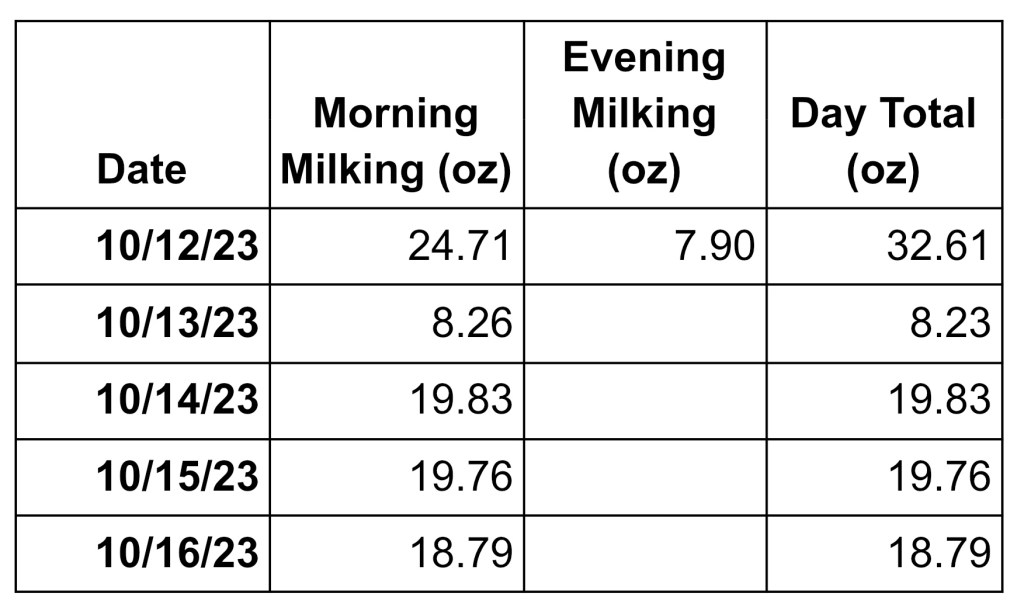
I probably could have given her a few more days of twice daily milking to see what kind of yield I’d get, but I have a pretty solid policy of not milking for anything less than 8 ounces. I figured I’d see what happened when I dropped down to a single milking, and for the time vs. yield equation, it was the right choice.
As for quality, the milk seems to have less cream, and it’s not as flavorful. I’m currently making a batch of cheese with it, but I have mixed it with Phoebe’s for cooking and the flavor was fine (Phoebe still has two babies she’s nursing, so she wasn’t involved in this small experiment).
Discussion
This is definitely a case in which I wish small scale equipment existed in the US and that it was affordable, as I would love to have tested the milk to know what actually happened to the quality. If you have this study for goats (dwarf nigerians, please), please send it to me! I have found plenty of info on skipping milking days for cows (this fact sheet from Australia is really helpful!), but obviously nothing for goats. With so much of goat herding happening in tbe global south, I imagine so many expert goat herders know the quality of their milk at various stages and what its best use may be in cases like this, and maybe someday I’ll figure out how to travel the world and capture those types of stories in a book.
In the interim, I also wrote up my milking procedure if it’s at all helpful for any of you who also had to Google “How do I milk a goat?” at some point in their life. I’ll post the procedure later this week!
Thank you for your tolerance of ads on this site; we may earn a very small amount of money for your visits thanks to the ads. If you would like to help support our work beyond this minimal ad revenue, please visit the Contact page to make a donation to the farm.



 Air's Wild Acres